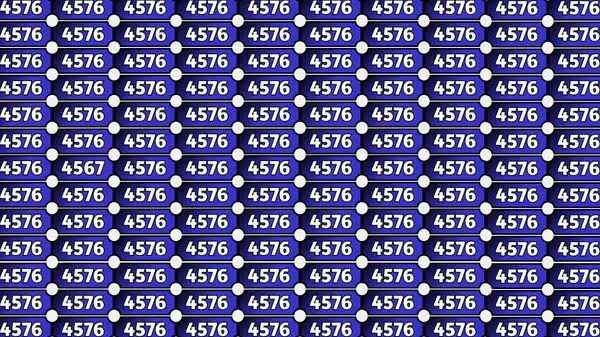
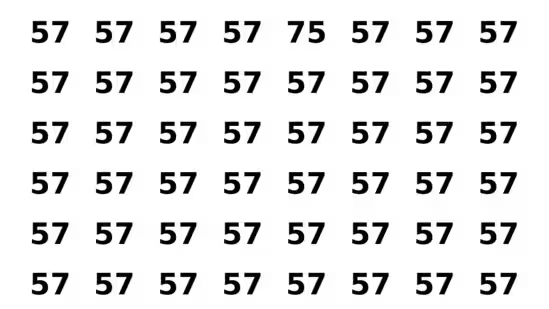
Have you ever looked at a wall full of numbers and suddenly felt like your eyes were playing tricks on you? Everything appears identical at first glance, yet somewhere in that pattern something is slightly different. That strange experience is exactly what makes this 7-second optical illusion challenge so fascinating.
In this brain teaser, the task sounds very simple. Your mission is to find the hidden odd number placed among dozens of 57s. At first it feels easy because spotting one number that does not belong should not be difficult. But there is a catch that makes it far more interesting. You only have seven seconds to do it.
Why Optical Illusion Number Puzzles Feel So Addictive
Visual puzzles create a unique kind of excitement because they challenge how our brain normally processes information. When we look at rows of identical numbers, our brain quickly groups them together so it can understand the pattern faster.
 14 Yoga Poses That Help Open Tight Hips Improve Mobility and Restore Comfortable Body Movement
This shortcut helps us in everyday situations, but during puzzles it actually becomes the main reason we miss the hidden difference. When your brain sees repeated 57s, it begins to treat them as a single visual pattern instead of separate digits.
Because of this grouping effect, the odd number can hide in plain sight. It might be there the whole time, yet your eyes simply skip over it.
These puzzles are not only entertaining but also beneficial. They help improve observation skills, sharpen attention to detail, and increase mental processing speed. Many people enjoy them during short breaks because they provide a quick but effective mental workout.
The Seven-Second Twist That Makes It Challenging
The real difficulty of this puzzle is not just spotting the different number. The real challenge is doing it within seven seconds.
When a timer is involved, pressure builds instantly. Instead of calmly examining each number, your brain begins scanning rapidly across the grid searching for something unusual.
This quick scanning can cause mistakes. A number like 75, 37, or 58 may be placed cleverly between rows of 57s. Since the digits look similar, your brain may overlook the difference in a split second.
Seven seconds feels short, but it is just enough time to test how sharp your observation really is. Did you manage to spot the odd number before time ran out?
Simple Tricks to Find the Odd Number Faster
If you could not locate the hidden number within seven seconds, there is nothing to worry about. These puzzles are meant to challenge your perception. However, a few small strategies can make solving them easier.
Start by avoiding the habit of reading the numbers as a complete pair. Instead of seeing “57” repeatedly, try focusing on the individual digits, especially the second digit in each pair.
 7 Yoga Poses That Quiet Anxiety and Reset Your Nervous System Through Calm Breath and Movement
Next, scan the numbers row by row rather than jumping randomly across the image. A structured scanning method prevents your brain from skipping important areas.
You can also slightly change your viewing distance or soften your focus for a moment. Sometimes altering your visual perspective helps break the pattern illusion.
Most importantly, stay relaxed. Rushing often leads to missed details, while calm observation improves accuracy.
What This Puzzle Reveals About Your Observation Skills
If you managed to find the hidden number within seven seconds, it suggests that you have strong visual attention and quick pattern recognition skills. People who solve these puzzles rapidly are usually very detail-focused.
If it took a bit longer, that is still impressive. Optical illusion puzzles are specifically designed to challenge the way our brains interpret visual patterns.
These challenges demonstrate how our minds rely heavily on shortcuts when processing information. Patterns can easily fool us, but with careful attention we can override those shortcuts and see the difference clearly.
That is exactly why optical illusions are so enjoyable. They remind us that the first glance is not always the most accurate one.
Why Short Brain Teasers Are Actually Good for Your Mind
Quick puzzles like this do more than just entertain. They encourage the brain to stay active and flexible. Just as physical exercise strengthens muscles, short bursts of mental activity help keep the brain engaged.
Regularly solving small challenges can improve concentration, reaction speed, and mental alertness. Students, professionals, and puzzle lovers often use these quick exercises to sharpen their focus.
They are also great for sharing. Send this puzzle to friends or family and see who can find the odd number the fastest. The results might surprise you.